Makhana wholesale price per kg: what decides the rate
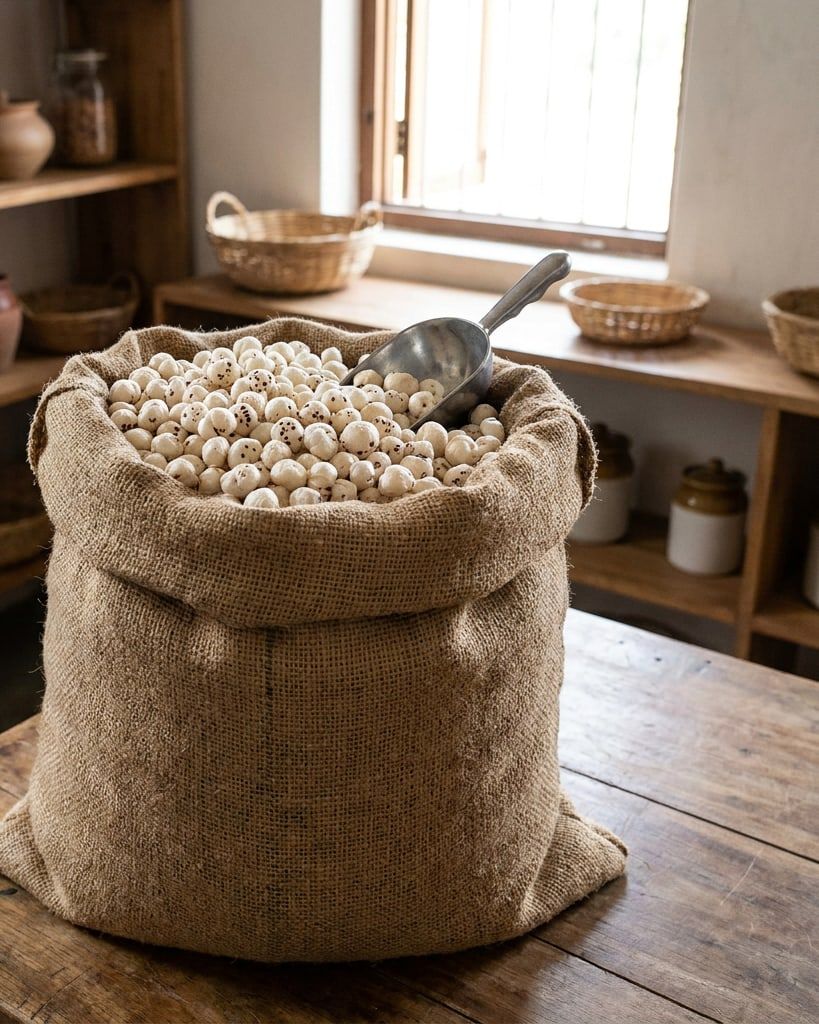
Search for the makhana wholesale price per kg and you will find dozens of numbers that do not agree. This guide does not add another one. It sets out what actually moves the rate, so you can tell whether two quotes describe the same makhana, and which one is cheaper per kilogram you can use.
Why there is no single rate
No mandi anywhere in India records makhana, so there is no official market price series, no futures contract and no way to hedge. What circulates are trade quotes and seller listings, and listings use grade names loosely enough that a “premium” lot on one site is not comparable with a “premium” lot on another. Our guide to buying makhana from Bihar covers the trade structure behind that.
APEDA’s monthly makhana dashboard does publish a trade-sourced range for each grade. Treat it as context for a negotiation, not as a quote: it is a range gathered from the trade, not a record of transactions.
1. Grade: kernel size in suta
Size is the largest single driver. The trade grades popped makhana by diameter in suta, where one suta is about 3.2 mm, and bigger kernels cost more. In APEDA’s May 2026 dashboard, the trade-sourced range for 7 suta was about twice the range for 4 suta. Across the trade’s full size ladder, from the smallest Thurri pops below 3 suta to the largest Rajbhog, ISEC recorded close to an eightfold spread in Bihar wholesale rates for 2024-25.
So a rate means nothing without a grade, and a grade means little without a millimetre band. Our grades run from 4 suta at 12–15 mm to 7 suta at over 21 mm, and what suta means explains how to write a grade into a purchase order.
2. One grade or a blend
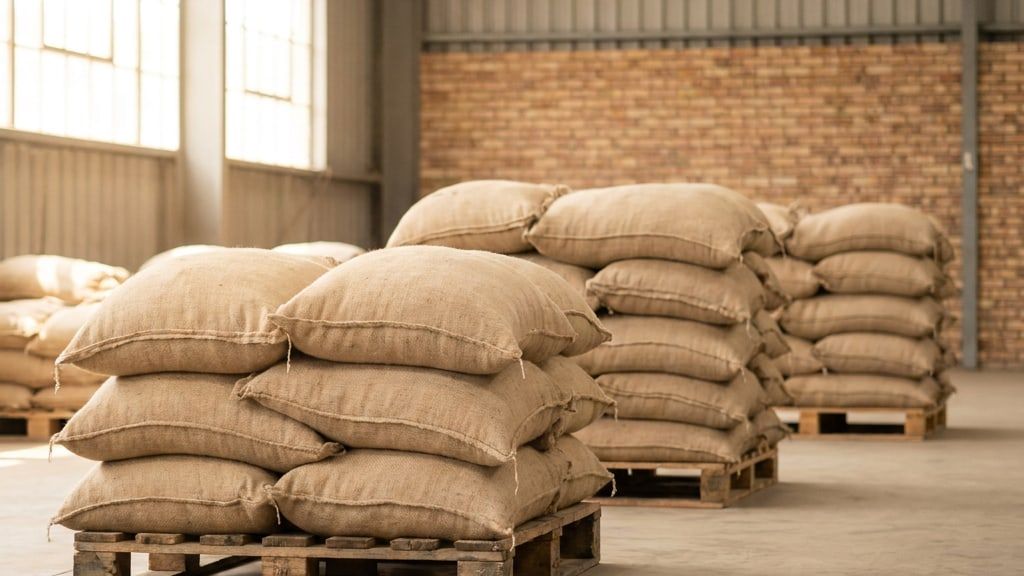
The traditional trade sells popped makhana in Bora bags, priced per bag by volume, with every size blended together. A buyer who cannot sieve each bag prices it down towards its worst content. A lot sold by weight against a single declared band is a different product from a blended bag, even when both carry the same grade name. Compare price per kilogram of kernels inside your band, not per bag.
3. Moisture
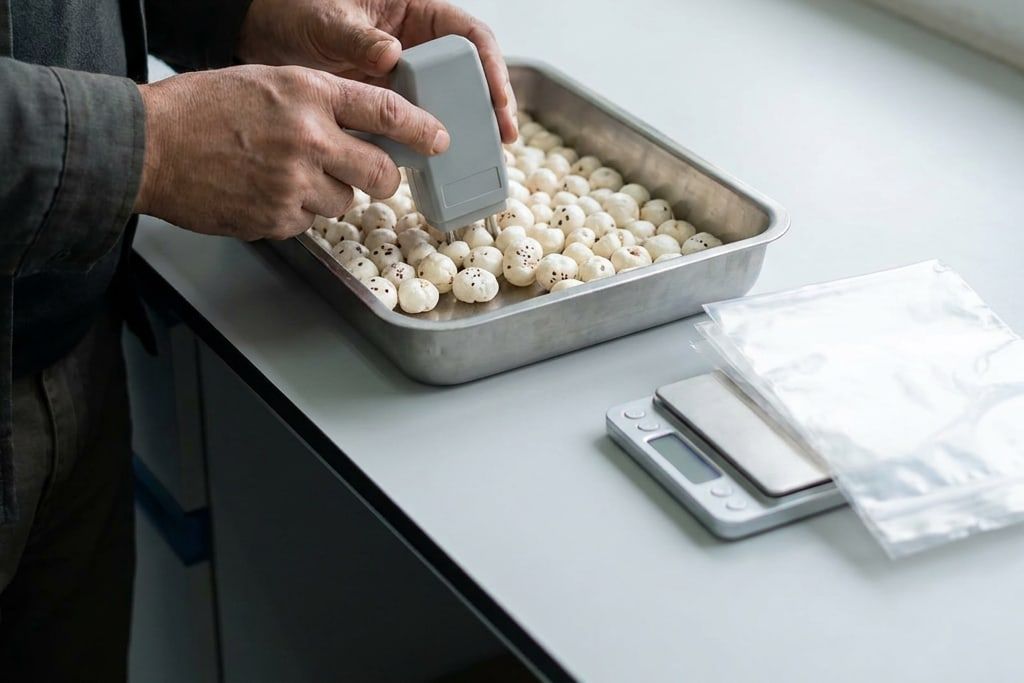
You pay for water by the kilogram. A lot at higher moisture carries less makhana per kilogram invoiced, and wetter makhana keeps less well in storage. Our standard ceiling is 7%, with a 4.5% low-moisture specification on 5, 6 and 7 suta. Ask every supplier for the reading at dispatch, the meter it was taken on, and when that meter was last calibrated.
4. Unpopped, broken and foreign matter
Every unpopped kernel, broken piece and stone in a lot is paid for at the makhana rate. Our limits run from 4% unpopped and 6% broken in 4 suta down to 2% and 3% in 6 and 7 suta, with foreign matter at 0.1% or lower in every grade. A cheaper quote with no stated limits may simply contain more of what you will throw away.
5. Raw seed and popping
Popped makhana is made from raw seed, called guri, which is roasted and popped by hand or machine. The share of seed weight that comes out as popped kernels varies from lot to lot, and published conversion figures disagree with each other without stating a moisture basis. That is why a raw-seed price does not convert cleanly into a popped-makhana price, and why a supplier quoting popped makhana off a seed price is guessing.
6. Season and stored stock
In the pond system the crop is harvested from August to October, and popping follows harvest. For most of the year the market runs on stored popped stock: APEDA stated that from November 2025 through August 2026 the Indian market would rely entirely on it. Prices move through the season, and every grade’s range in APEDA’s dashboard changed between January and May 2026, but published sources do not agree on which way prices run within a season. Do not plan around a rule of thumb. Get dated quotes, and book ahead of the festival windows you are buying for.
7. Lot size
A lab test, a certificate of analysis and a dispatch cost much the same for a small lot as for a large one, so small lots carry more of those costs per kilogram. Our lots run from 500 kg to 2 tonnes, after a paid pilot lot of 100–300 kg.
8. Testing
Ask what the quote includes. On our 6 and 7 suta lots, microbiology is tested on every lot and pesticide residues on request; aflatoxin is tested on a rotating sample across lots, or on every lot if you ask. Every lot ships with a certificate of analysis issued before dispatch. A quote that includes per-lot laboratory work is not comparable with one that does not.
9. Packing
Lined, sealed bulk bags cost less than retail-ready packs, and export lots are packed in nitrogen-flushed export packing. Packing is part of the rate, so make sure two quotes assume the same format.
10. Freight and delivery basis
Popped makhana is light and bulky, so a truck or container fills by volume long before it reaches its weight limit, and freight per kilogram is higher than for a dense commodity. A delivered rate and an ex-works rate are not comparable. Export lots are quoted FOB only, so the buyer, who controls the freight, sees its true cost. See freight for a bulky product.
11. Payment terms
Credit costs money. Our pilot lots are paid in advance, or half in advance and half against a dispatch video; repeat orders move to 15-day credit after three clean cycles. Export lots are paid by letter of credit, or 50/50 against documents. These are standard terms, confirmed in writing with every quote.
How to compare two quotes
Put both quotes side by side and check that each one states:
- the grade as a suta name and a millimetre band;
- the moisture ceiling at dispatch, and the meter;
- limits for unpopped, broken and foreign matter;
- the lot size;
- the laboratory tests included, and whether a certificate of analysis comes before dispatch;
- the packing format;
- the delivery basis: ex-works, delivered, or FOB;
- the dispatch date;
- the payment terms.
If a quote is silent on any of these, ask before you compare prices. Ours state all nine. Ask for a quote with your grade, quantity and dispatch date, or read our wholesale terms and export terms.
Sources
- APEDA Market Intelligence Cell, makhana dashboard, May 2026 edition: trade-sourced domestic price ranges by grade, January to May 2026. PDF
- APEDA Market Intelligence Cell, makhana dashboard, November 2025 edition: size bands by suta, and reliance on stored popped makhana from November 2025 to August 2026. PDF
- APEDA Market Intelligence Cell, makhana dashboard, September 2025 edition: the crop calendar and the August to October harvest window. PDF
- ISEC Policy Brief 70, Suta-based measurement system: the suta unit, the trade’s size ladder with 2024-25 Bihar wholesale rates, and the Bora system. PDF