How to import makhana from India: terms, documents and HS codes
This guide is for importers buying fox nuts (makhana) from India: how to specify the grade, which Incoterm and payment terms to expect, which documents to agree before you order, how export lots are packed and tested, how long dispatch takes, and which HS codes India uses for makhana. Where we describe our own offer, these are standard terms, confirmed in writing with every quote.
Specify the grade in millimetres
The Indian trade grades makhana by kernel diameter in suta. Write the millimetre band first and the suta name second, so your supplier, your laboratory and your customer all read the same thing:
| Diameter | Trade grade |
|---|---|
| 12–15 mm | 4 suta |
| 15–18 mm | 5 suta |
| 18–21 mm | 6 suta |
| over 21 mm | 7 suta |
Each lot we ship is a single grade, with no blending. See our grades for the limits that apply to each, and what suta means for how the trade names map to millimetres. If your market knows makhana as lotus seeds, read makhana, fox nut and lotus seed before you write the label.
Incoterms: we quote FOB
We quote export lots FOB (Free on Board, Incoterms 2020) at a named Indian port. Under FOB the seller clears the goods for export and loads them on the vessel; from that point the buyer carries the risk and contracts the ocean freight and insurance.
There is a practical reason for FOB with makhana. Popped makhana is light and bulky, so a container fills by volume long before it reaches its weight limit, and the freight cost per kilogram is high. On FOB terms the buyer, who chooses the forwarder and the route, controls that cost directly. We do not quote CIF or DDP. Our guide to buying makhana from Bihar explains the freight arithmetic.
Payment
Export lots are paid by letter of credit, or 50% in advance and 50% against shipping documents. Before a full lot we start with a sample kit and a paid pilot lot of 100–300 kg, so you can run your own incoming QC on real material. Full lots run from 500 kg to 2 tonnes.
Documents
Documentation is confirmed in writing before any purchase order. Requirements depend on your country, your product and your buyer, so agree the list up front rather than discovering a gap at the port. Importers commonly ask for:
- a commercial invoice and a packing list;
- the bill of lading;
- a certificate of origin;
- a certificate of analysis tied to the lot ID on the packs;
- any health, phytosanitary or registration document your import authority requires.
Ask your customs broker which documents your country needs for popped makhana, and send us that list with your enquiry. We confirm in writing which documents will travel with the lot before you issue a purchase order.
Testing and the certificate of analysis
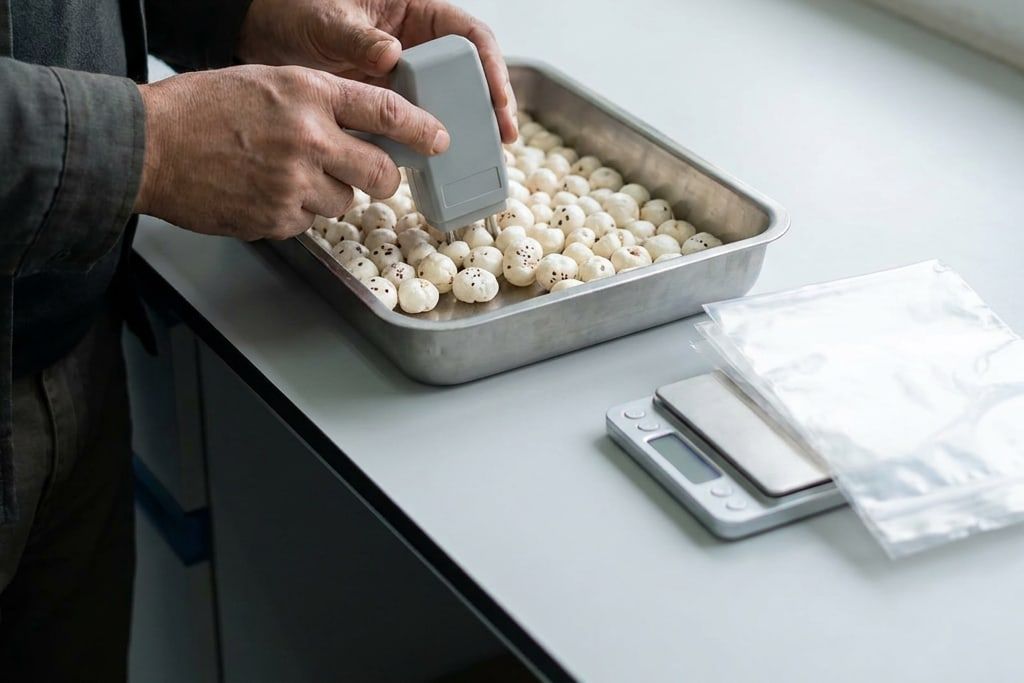
Every lot ships with a certificate of analysis issued before dispatch, with a QR code that resolves to its verification record, and every lot is traceable from the pond cluster to dispatch. Laboratory work goes to NABL-accredited laboratories in India. On 6 and 7 suta, microbiology is tested on every lot and pesticide residues on request; aflatoxin is tested on a rotating sample across lots, or on every lot if you ask. A sample from every lot is retained for 12 months.
If your market sets its own limits, write them into the specification and we will quote against them. Our guide to checking makhana quality covers the tests that matter and how to read a certificate.
The European Union
EU destinations are quoted after lot testing. Commission Implementing Regulation (EU) 2023/652 authorised roasted and popped Euryale ferox kernels as a traditional food from a third country, with a specification that includes limits for pesticide residues, aflatoxins, acrylamide and microcystins, and moisture below 5.0%. Each lot is tested against that specification before we quote it for the EU. The authorisation does not cover makhana flour.
Packing
Export lots are packed in nitrogen-flushed export packing, a standard term confirmed in writing with every quote. Each pack carries the lot ID shown on the certificate of analysis. Pack size and outer carton are agreed with you in the quote. Our standard moisture ceiling is 7%, with a 4.5% low-moisture specification available on 5, 6 and 7 suta.
Lead times
Graded stock lots dispatch within 7 days of your purchase order, and made-to-order lots within 21 days. These are standard terms, confirmed in writing with every quote. Transit time after loading depends on the port pair and the carrier your forwarder books.
HS codes for makhana
India’s export (ITC-HS) schedule carries three makhana lines, listed on APEDA’s May 2026 makhana dashboard:
| India export code (ITC-HS) | Description |
|---|---|
| 20081921 | Makhana, popped |
| 20081922 | Makhana flour and powder |
| 20081929 | Other makhana preparations |
APEDA notes that makhana previously shipped under a broader code and moved to these lines from July 2025. The first six digits follow the international Harmonized System; the last two are India’s own, and your country’s tariff may split the heading differently. These are India’s export codes. Confirm your import tariff line with your customs broker.
Social compliance
If your customers audit their supply chains, ask about labour in processing. Every processing agreement we sign carries a clause that bars workers under 18, with a right of unannounced inspection. Our Bihar sourcing guide explains why it matters.
Your first shipment, step by step
- Send your requirement: grade in millimetres, quantity, destination port, the tests and the documents your market requires.
- Sample kit: check size, moisture and appearance in your own QC.
- Paid pilot lot of 100–300 kg: run it through your incoming QC and, if you sell it on, your customer’s.
- Quote for full lots: terms, tests and documents confirmed in writing before any purchase order.
- Purchase order and payment: letter of credit or 50/50 against documents; the certificate of analysis is issued before dispatch.
Ready to start? Send your requirement, or read our export terms and the Mithila makhana origin page.
Sources
- APEDA Market Intelligence Cell, makhana dashboard, May 2026 edition: HS codes 20081921 (makhana popped), 20081922 (makhana flour and powder) and 20081929 (other), assigned from July 2025. PDF
- Commission Implementing Regulation (EU) 2023/652, Official Journal L 81, 21 March 2023: authorisation and specification for roasted and popped Euryale ferox kernels. PDF
- International Chamber of Commerce, Incoterms 2020 rules. Page